
Distributed engineering is now a standard operating model for a large number of technology companies. Yet the challenge that consistently undermines it is not technical. It is coordination. When team members are separated by six or more hours, the informal communication that holds co-located teams together disappears, and what remains is a coordination structure that either works by design or fails by default.
Managing a distributed team well is not about replicating office culture at a distance. It is about building systems that allow asynchronous work to progress without constant synchronous intervention. That distinction matters, and the practices that follow from it are specific.
What a Dedicated Development Team Is and Why Distribution Complicates It
A dedicated software development team is a group of engineers assembled by a vendor to work exclusively on one client’s product. Team members follow the client’s processes, use the client’s tools, and are accountable to the client’s management rather than to an internal vendor hierarchy. In other words, they function as an extension of the internal engineering organization rather than as an external contractor executing a defined scope.
Given this structure, time zone separation introduces a specific problem. The team has the organizational characteristics of an internal team, including shared ownership of outcomes and ongoing collaboration requirements, but it lacks the physical proximity that makes informal coordination easy. That’s why deliberate process design matters more in dedicated team engagements than in fixed-scope outsourcing, where interaction is naturally limited to handoffs and reviews.
When Distributed Dedicated Teams Make Sense
You should attentively analyze whether a distributed engagement model fits your operational context before choosing a vendor based on geography or cost alone.
Distributed dedicated teams work well when:
- the client organization already operates with documented processes and asynchronous communication habits;
- the project scope is large enough to justify the coordination investment required to manage time zone separation effectively;
- the required technical expertise is not available locally and the talent pool in the vendor’s location is demonstrably stronger;
- the client team has a designated technical lead or product owner who can provide timely input during the overlap window.
Apart from this, the model may introduce more friction than value when the product direction is highly uncertain and requires rapid, iterative conversation between engineering and product stakeholders. Frequent directional changes are significantly harder to manage across time zones than stable, well-defined development work.
How to Structure Communication Across Time Zones
Communication structure is the most critical variable in distributed team management. A lot of organizations treat communication as something that will organize itself once the team is in place. It does not. What is also important here is that the communication structure needs to be defined before the engagement begins, not discovered through trial and error after misalignment has already occurred.
Defining the Overlap Window
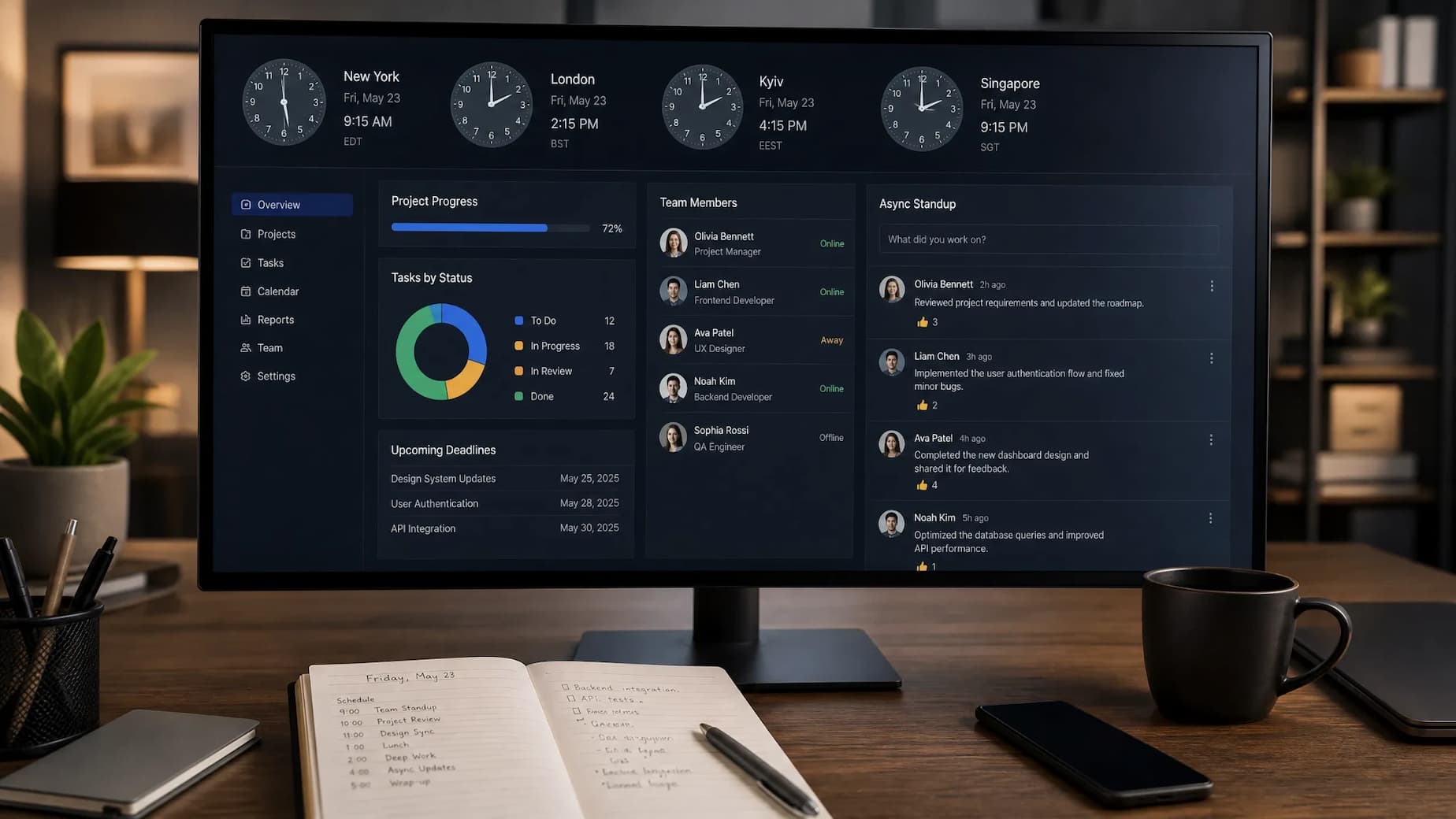
The overlap window is the period during which both the client team and the dedicated team are simultaneously available. It will be helpful to treat this window as a protected resource rather than a flexible block that can absorb scheduling conflicts.
We recommend the following approach for structuring the overlap window:
- Identify the actual working hours of both teams and calculate the real overlap, accounting for local holidays and flexible schedules.
- Reserve the overlap window exclusively for synchronous communication: daily standups, technical clarifications, and sprint ceremonies.
- Protect the remaining hours on both sides for focused, asynchronous execution rather than ad hoc meetings.
Pay attention to the size of the overlap window when selecting a vendor. Less than three hours of genuine daily overlap creates coordination delays that compound across a sprint and produce missed dependencies and rework.
Asynchronous Communication Standards
The majority of communication in a distributed dedicated team engagement should be asynchronous. This is not a concession to time zone constraints; it is a structural advantage when managed correctly. Asynchronous communication creates a written record of decisions, reduces the meeting load on both sides, and allows engineers to work in uninterrupted focus blocks.
What a reliable asynchronous communication setup should include:
- a single source of truth for project documentation, accessible and up to date for all team members;
- clear conventions for how tasks are documented, including acceptance criteria, context, and priority;
- a defined response time expectation for asynchronous messages, typically within one business day;
- a distinction between channels for urgent issues and channels for non-urgent updates.
Thanks to this structure, team members can make progress on their local working day without waiting for a synchronous conversation to unblock them.
How to Run Sprint Ceremonies Across Time Zones
Sprint ceremonies, including planning, review, and retrospective sessions, require synchronous participation. Managing them across time zones requires scheduling discipline and a consistent format that makes the most of the overlap window available.
Scheduling Principles
We recommend scheduling all recurring ceremonies at the same time each sprint cycle. Predictable scheduling allows both teams to plan their working days around the ceremony rather than treating it as an interruption. It will be helpful to rotate ceremony times occasionally if the overlap window is asymmetric, so that the time cost of early or late attendance does not fall entirely on one side.
Making Ceremonies Productive
A lot of distributed sprint ceremonies fail not because of the time zone difference but because of poor facilitation. Typical issues include unclear agendas, presentations that run over time, and decisions that are not documented before the call ends.
To run effective ceremonies across time zones, the following practices should be in place:
- distribute the agenda and any required pre-reading at least 24 hours before the session;
- assign a facilitator responsible for timekeeping and ensuring all participants contribute;
- document decisions and action items in a shared system during the call, not after;
- keep sprint reviews focused on demonstrated working software rather than status updates.
These mechanics boost the information-to-time ratio of each session and reduce the need for follow-up clarification, which is particularly costly when clarification requires waiting for the next overlap window.
How to Maintain Team Cohesion Without Physical Co-location
Technical output in a dedicated team engagement depends partly on engineering skill and partly on team cohesion. Teams that communicate well, trust each other, and share a clear understanding of the product they are building outperform technically stronger teams with poor interpersonal dynamics.
Building cohesion across time zones requires intentional effort. It will be helpful to schedule periodic informal interactions that are not tied to project deliverables. This could include virtual team sessions, shared retrospective formats that include personal reflection alongside process feedback, or occasional travel for in-person meetings at key project milestones.
What is also important here is onboarding. New team members joining a distributed dedicated team need structured onboarding that introduces them to the product, the codebase, the client team’s ways of working, and the people they will collaborate with. Remote onboarding that consists only of documentation review produces engineers who can execute tasks but lack the context to make good independent decisions.
Conclusion
Managing a dedicated development team across time zones is a solvable problem, but it requires deliberate design rather than improvisation. The organizations that do it well share a common approach: they define communication structures before the engagement begins, protect the overlap window for synchronous collaboration, and invest in asynchronous practices that allow both teams to make progress independently.
We recommend treating time zone management as a core operational competency rather than a logistical inconvenience. The teams that build this competency consistently outperform those that rely on effort and goodwill to compensate for the absence of process.

Flexibility, efficiency, and individual approach to each customer are the basic principles we are guided by in our work.
Our services