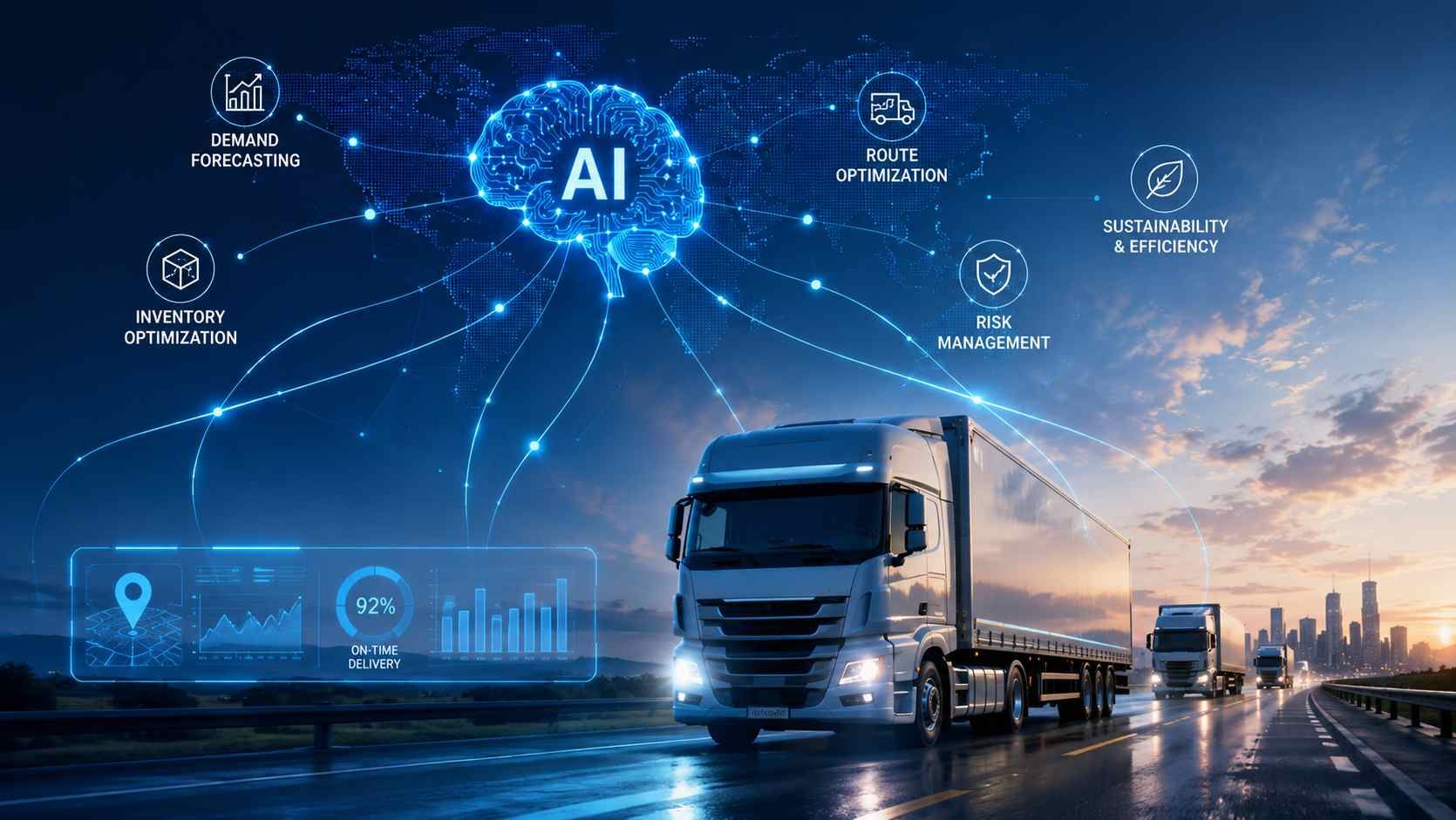
The logistics industry is undergoing one of the most significant transformations in its history — and AI is at the center of it. The global AI in logistics market was valued at $20.1 billion in 2024 and is projected to grow at a CAGR of 25.9% through 2034 (GM Insights). Ground-level adoption confirms the momentum: 38% of logistics companies already deploy AI solutions, and by 2025, analysts expect 95% of evidence-based logistics decisions to involve some form of automation.
This isn’t hype — it’s operational reality for companies like Amazon, DHL, and Maersk, and increasingly for mid-market players who can no longer compete without intelligent systems. Here are seven areas where AI is reshaping how goods move, where they’re stored, and how much it all costs.

1. Predictive Demand Forecasting
Traditional demand forecasting relied on historical averages and spreadsheets. AI-powered systems go further, analyzing hundreds of variables simultaneously — sales history, seasonal patterns, weather events, social media sentiment, and real-time competitor pricing.
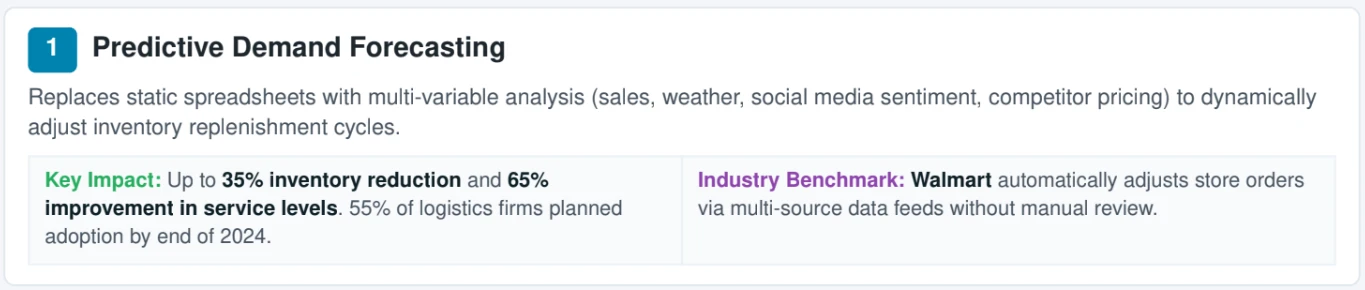
The results are measurable. Companies using AI for demand forecasting report inventory reductions of up to 35% while simultaneously improving service levels by 65%. According to UPS, 55% of logistics companies planned to adopt AI-driven demand forecasting by end of 2024. Walmart’s AI model processes data from thousands of store locations alongside weather feeds and local event calendars, adjusting replenishment orders automatically and eliminating manual review cycles.
For perishables, pharmaceuticals, and fast fashion, this level of accuracy is no longer a differentiator — it’s the entry point.
2. Route Optimization and Last-Mile Delivery
Fuel accounts for 30–40% of total trucking costs. Last-mile delivery adds another layer of pressure: it represents 53% of total shipping costs yet carries the highest customer expectations.

AI route optimization addresses both problems. Unlike static GPS routing, these systems factor in traffic patterns, driver hours-of-service regulations, delivery time windows, vehicle capacity, and fuel efficiency — and update dynamically as conditions change. UPS’s ORION system analyzes 250 million route possibilities per driver per day, saving an estimated 100 million miles and 10 million gallons of fuel annually.
Autonomous delivery pilots — drone delivery by Amazon Prime Air, sidewalk robots by Starship Technologies — represent the next frontier, with AI handling both navigation and real-time obstacle avoidance.
3. Warehouse Automation and Robotics
The modern AI-powered warehouse runs around the clock without fixed workflows. Autonomous mobile robots (AMRs) navigate dynamically using computer vision and real-time mapping, adapting to floor changes and routing around obstacles. AI coordinates inventory placement, pick-path optimization, and outbound sorting simultaneously.

Approximately 50% of logistics companies are deploying or planning AI-driven warehouse robotics. Amazon operates over 750,000 robots across its global fulfillment network. UK-based Ocado runs AI-controlled warehouses where thousands of robots make coordinated 50-millisecond decisions with no human intervention on the floor.
AI-driven inventory slotting — placing products based on velocity, seasonality, weight, and co-purchase frequency — alone reduces picking time by 20–30%.
4. Predictive Maintenance
Equipment failure in logistics has cascading consequences. A broken conveyor belt halts hundreds of shipments. A truck breakdown mid-route creates delays across an entire delivery sequence. A refrigeration failure in cold-chain logistics can destroy entire loads of pharmaceuticals or perishables.

Predictive maintenance uses AI to catch failures before they happen. Sensors on vehicles, machinery, and warehouse equipment stream operational data — vibration, temperature, pressure, fuel consumption — to ML models trained to detect anomaly patterns that precede failure.
Companies implementing these systems report 25–30% reductions in unplanned downtime and maintenance cost savings of 10–25%. DHL deploys predictive maintenance across its fleet, monitoring engine health and scheduling repairs during low-traffic windows rather than responding to emergencies mid-operation.
5. Real-Time Supply Chain Visibility
Modern supply chains span dozens of countries and thousands of handoff points. Without real-time visibility, any disruption — a port closure, severe weather, a geopolitical event — leaves logistics managers reacting rather than responding.

AI-powered visibility platforms aggregate data from IoT sensors, carrier APIs, customs databases, weather feeds, and news sources. Machine learning models parse this continuously, identifying risks and triggering alerts before disruptions escalate. The payoff: companies with AI-driven visibility report up to 30% better transit times and significantly lower exception handling costs.
Maersk’s TradeLens platform (built with IBM) provides end-to-end ocean freight visibility shared across shippers, ports, customs authorities, and inland carriers — enabling proactive rerouting and faster clearance. Retail and e-commerce currently leads all sectors with 83% AI supply chain adoption, driven by the precision their delivery promises demand.
6. Intelligent Document Processing and Customs Automation
Logistics generates a massive documentation burden: bills of lading, customs declarations, certificates of origin, invoices, and proof-of-delivery records. Manual processing is slow, error-prone, and a bottleneck at every cross-border handoff.

AI-powered document processing uses NLP and OCR to extract, validate, and route information from unstructured documents automatically. Systems cross-reference data across multiple documents, flag inconsistencies, and pre-populate customs declarations without human input. A single incorrect HS code can delay a shipment for days — AI systems trained on thousands of past declarations classify goods accurately and predict customs clearance timelines with high reliability.
Flexport’s AI platform automates significant portions of its customs brokerage workflow: extracting product data from invoices, applying the correct tariff codes, and generating compliant import filings in minutes rather than hours.
7. Dynamic Freight Pricing
Freight markets are volatile. Fuel costs spike, capacity tightens after weather events, and demand surges catch carriers off guard. Static pricing models either leave revenue on the table during peak demand or erode margins during downturns.

AI-powered dynamic pricing adjusts freight rates in real time based on capacity utilization, competitor pricing, lane-level demand, seasonal patterns, and macroeconomic signals. Companies leveraging AI for pricing optimization report margin improvements of 5–15% on freight spend — significant given that logistics costs represent 10–15% of revenue for most manufacturers and retailers.
Uber Freight uses machine learning to price spot market loads dynamically, balancing shipper demand against available carrier capacity on each individual lane. Carriers use equivalent systems on the sell side to maximize load factor and revenue per mile across their networks.
From Use Cases to Implementation
These seven applications range widely in implementation complexity. Some — like document processing or dynamic pricing — can be deployed as standalone tools with short integration timelines. Others, like full warehouse automation or predictive maintenance networks, require significant infrastructure investment and purpose-built development.
The choice of technology partner determines whether these projects deliver ROI or stall at the pilot stage. Strong logistics software development expertise means more than AI knowledge — it requires understanding how TMS, WMS, and ERP systems connect, where data pipelines break down, and how to design solutions that scale beyond a single warehouse or lane.
The companies gaining the most from AI in logistics today aren’t those with the largest budgets. They’re the ones that identified a specific operational problem, selected the right technology, and executed integration without shortcuts. The use cases are proven. The question is where your operation has the most to gain — and how quickly you move on it.

Flexibility, efficiency, and individual approach to each customer are the basic principles we are guided by in our work.
Our services